
|
|
For Industry Professionals Book and DVD Knowledge Means Growth One of the first steps toward becoming a professional is being fully knowledgeable about a subject or product. Recently, I visited a sporting goods store and wanted to buy a new pair of tennis shoes. As I approached a rack of about eighteen different styles, I asked the sales person to update me on the latest tennis shoe designs and materials because it had been several years since I bought my last pair. His response was, “Well, ah, these are the tennis shoes…and, ah, I mean, they're pretty much like what we, ah, had last year.” Then I said, “But I can see there’s a big difference in price between $34.95 and $124.95. There must be something that makes one pair different from the other!” The sales person said, “Well, ah, I really don’t know.” I smiled and left the store. Individuals who intend to work in the fabric industry are expected to know the product they are representing, as well as the product of competitors, whether it is for residential interiors, contract interiors, or both. If an experienced interior designer enters a showroom and asks a sales representative for a silk and cotton damask blend with a strie or possibly for a matelasse and the sales person has no idea what they are talking about, this would not be good. Bad news, unfortunately, travels faster than good news and the designer who was frustrated with the sales person who could not accommodate them might tell other designers about their experience and consequently affect the business of a to-the-trade fabric provider over time. The Book From window treatments to carpets to material laminated between translucent sheets of resin used for room dividers, fiber and fabric plays a major role in the interiors we live and work in. But fabric knowledge begins by knowing more than what has been newly colored or what design appears fashionable. It is about first understanding what fabric for interiors is all about and where to use the variety of qualities.
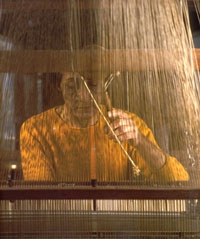
The DVD Designers are typically visual learners and consequently respond well to color, texture, and moving images. The 120-minute DVD that accompanies the book provides a tour of a 110,000 square foot mill showing how woven and printed fabric and trimming is constructed. The process is tracked from the design studio to inspection. Various looms including dobby and jacquard are explained and shown in operation. The second part of the DVD takes the viewer to several to-the-trade showrooms in a New York City design center. The focus of one showroom visit is to explain how a successful showroom functions. The manager reveals how to establish an account, read tags, acquire samples to show clients, and understand pricing and ordering procedures. Detailed job descriptions of all essential employees are also reviewed. Both residential and contract fabric showrooms are filmed, reinforcing and illuminating content found in the book. The book and DVD are presented in full color. Mill and showroom employees are featured in each of the DVD segments. |
 Fabric for the Designed Interior is a book for designers, fabric suppliers, editors, converters, and fabric sales personnel who work inside or outside the showroom, addressing both residential and commercial interiors. The first part of the book places fabric in a historic context, examining its contribution to the growth of civilization. Additional topics include sources of early fibers and filaments, yarn construction, fabric types, carpets and rugs, trimming, and the evolving technologies of fabric production. Other chapters provide methods of successfully specifying fabric, dealing with environmental and safety concerns, understanding fabric and carpet care issues, working with bids and contracts, and learning strategies for navigating through showrooms and fabricating facilities. Leading designers, fabric manufacturers, and suppliers also weigh in with their experiences through interviews in Chapter 12.